
What happens when humans stop visiting the Moon — and start being from it?
The Artemis II crew splashes down in the Pacific today—the first humans to travel to the Moon and back in over fifty years. Everyone is focused on the homecoming. I keep thinking about the people who won’t be coming home.
Here’s a question nobody is asking yet, but somebody should be: what do you call a human being who has never been to Earth? Not an astronaut. Not a visitor. A person born on the Moon, raised there, whose body—shaped by one-sixth of Earth’s gravity from the very beginning—could not survive Earth’s pull even if they wanted to try.
We don’t have a word for that yet. But we will. And when we do, it will mark the moment the Moon stops being a destination and becomes a one-way door.
I started thinking about this as a space question. It didn’t stay there. It turned into something bigger: what makes a people a people, and what happens when the environment that shaped us for 200,000 years simply isn’t there anymore?
Start with the biology, because everything else follows. The human body is a solution to Earth. At 1g, bones need density, muscles carry weight, and the heart works against gravity all day. Remove that constant pull—as on the Moon—and the body stops maintaining what it no longer needs. Astronauts already show us the first version of this: bone density drops, muscles weaken, the heart doesn’t have to work as hard, and can shrink in size.
Stretch that across generations, and you don’t just get adaptation—you get divergence. A lunar-born population would likely be taller, lighter-framed, with a cardiovascular system tuned to a world where gravity barely pushes back. Physically distinct. And effectively unable to come home.
Returning to Earth wouldn’t feel like going back. It would feel like trying to live under six times your body weight. The heart couldn’t compensate. The bones couldn’t carry it.
That’s the part that changes everything. We tend to think of space as exploration—people go, do something extraordinary, and return. But the moment children are born somewhere else, the return path starts to close. By the time their grandchildren are grown, it’s gone. Not as a choice. As a physical fact.
I think of this as the one-way door. And once you see it, a permanent lunar colony stops looking like an outpost and starts looking like the beginning of something else.
The politics follow. The first large, permanent colony would almost certainly be American—or at least U.S.-run—or run by a U.S.-led partnership—operating under a charter, the way Jamestown did. The colonists are employees. Earth builds the infrastructure. Earth sets the rules. That works until a generation is born that never signed any agreement, never left Earth, never chose any of it. A generation that sees Earth not as home, but as somewhere else.
At some point, they’ll also realize they have leverage—especially if the colony produces resources Earth depends on. At that point, the conversation changes. We’ve heard it before. The American colonists had it with England, about 150 years after Jamestown. The Lunari—the name I keep coming back to—would have it with Washington. Only this time, there’s no Navy to send as the British did.
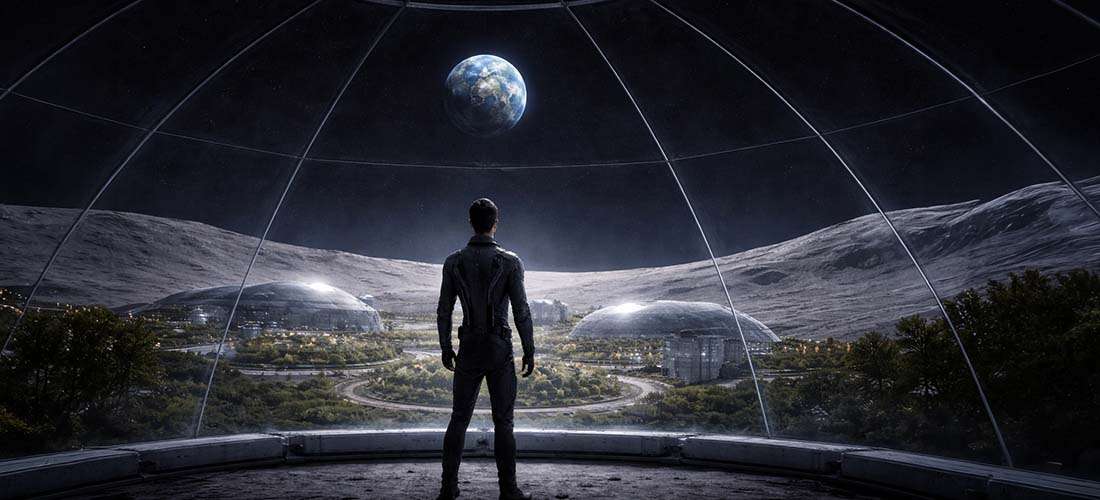
Then there’s what they believe. Religion on Earth is shaped by Earth—deserts, rivers, seasons, sky. Take all of that away and replace it with sealed corridors, artificial light, and a window where Earth hangs in the distance—beautiful, unreachable—and something else has to fill that space.
My sense is that the sacred shifts. Not upward, but inward. The systems that keep people alive—the air recyclers, the water loops, the power grid—stop being background infrastructure and start to feel more like ritual—like scheduled filter changes and leak checks that everyone participates in. Maintenance becomes moral. Attention becomes a virtue.
On Earth, nature sustains you whether you deserve it or not. On the Moon, survival is earned every hour. The deepest failure wouldn’t be disbelief. It would be neglect.
What’s striking is how familiar the pattern is. Walk far enough from where you started, stay long enough, have enough children—and something new eventually looks back. The Māori were Polynesian once. The Americans were British. The process isn’t new. What’s new is the speed and the physics.
The Lunari won’t be aliens. They’ll be us, continued—carried forward by the same curiosity and restlessness that pushed our ancestors out of Africa 70,000 years ago. Just pointed somewhere we’ve never pointed before.
And one day, one of them will stand at a window, look at the blue Earth hanging in the dark, and feel about it the way you feel about a place you’ve only ever heard stories about. Somewhere, a grandmother left. Somewhere real, and distant, and not quite home.
What an amazing exploration of what the future holds and well thought out! I wonder if it will reveal the core of what it means to be human when so much else has to adapt and diverge!
The lawyer in me cannot help but asking questions. For the past two nights I have lost sleep formulating questions for you to consider. The subject matter of my questions is too mundane to warrant inclusion in your analysis but perhaps an observation which seems to be recurring may make a difference as you develop this concept further. Why not view your theory as an opportunity to right what God intended in his original act of creation. If life develops as you envision on a virgin surface perhaps, we can avoid and even eliminate the imperfections that have plagued humanity since the infamous bite of the forbidden apple. Being a dreamer, I can envision a space that is unspoiled by human weakness, selfishness, avarice ,greed and all the other maladies we have inflicted on ourselves. Peace and harmony reign supreme and our Creator has reason to smile at the outcome.